Popular Links
Choose Services
Tree Planting
Tree Planting in Racine
The City of Racine is committed to growing and sustaining a healthy urban forest by planting diverse, high-quality trees in our parks, parkways, and public spaces. Tree planting expands our canopy, which improves air and water quality, reduces stormwater runoff, lowers energy costs, and enhances neighborhood beauty, increases property value and creates a “Sense of Place”.
What We Do
We’re growing Racine’s urban forest one tree at a time.
- Replacing removed trees
- Adding trees in neighborhoods with low canopy
- Planting along completed road projects
- Responding to requests from residents and businesses
- Following industry standards to ensure every tree thrives for years to come
Our Impact
The Forestry DivisionThe act or process of dividing; state of being divided. is proud to be a state leader in municipal tree planting.
- 1,300+ trees planted every year
- More than a decade of consistent growth
- A stronger, healthier, and more resilient urban forest for Racine’s future
Get Involved
- Submit a request for a free tree to be planted
- Or, plant a tree yourself on public property (with a Tree Permit)
Together, we can keep Racine green and growing.
Memorial Tree Planting Program
Honor a loved one with a memorial tree in Racine’s public spaces.
Where Memorial Trees Can Be Planted:
- City parks: Memorial trees can be planted within parks, but not in parkways along streets.
- Additional approved locations (with property manager approval):
- Washington, Shoop, and Johnson Golf Courses
- Mound Cemetery and Graceland Cemetery
- Wustum Museum
- Racine Zoo
- Other city-controlled properties (e.g., library, fire stations, city hall)
City staff can help select an appropriate tree species and a suitable location. The City Forester has final approval on species and planting location.
Options for Planting a Memorial Tree:
- Purchase a tree yourself from a nursery. City arboristsA specialist in the care and maintenance of trees will plant it upon delivery.
- Donate funds for the city to purchase the tree as part of our annual tree planting program. City arboristsA specialist in the care and maintenance of trees will handle the planting.
See the Memorial Tree Program Application for more details.
General Tree Planting Standards
All trees in Racine are planted according to accepted industry standards set by the International Society of Arboriculture. For detailed guidance on proper tree planting, visit TreesAreGood.org.
Key Standards:
- Follow industry standards: All trees must be planted according to ISA guidelines to ensure health and longevity.
- Tree permits for residents:
- A permit is required if a resident wants to purchase and plant a tree themselves.
- See Tree Permits for the application process.
- Permit holders are responsible for all costs and must plant the tree in the approved location following proper planting instructions.
- Planting season:
- Trees should be planted when dormant — typically early spring or late fall.
- With prior approval and extra care, trees may be planted outside these seasons.
Tree Species
At the City of Racine, we carefully select a diverse mix of tree species for planting across the city. A variety of species helps create a resilient urban forest that is better able to withstand pests, diseases, and environmental changes.
Our Forestry DivisionThe act or process of dividing; state of being divided. brings years of expertise to every planting. Our arboristsA specialist in the care and maintenance of trees:
- EvaluateTo judge or calculate the quality, importance, amount, or value of something each site to determine the best species for soil, sunlight, and space conditions
- Consider long-term growth, canopy coverage, and maintenance needs
- Follow industry standards to ensure every tree thrives for decades
By choosing the right tree for the right location, we not only enhance the beauty and shade of our neighborhoods but also strengthen Racine’s urban forest for future generations.
Fun fact: Over the past decade, our team has planted more than 1,300 trees per year, selecting species that balance diversity, sustainability, and visual appeal.
Tree Watering
Proper watering is essential for the health of Racine’s new trees. We ask residents to help care for public parkway trees and their private trees, especially during dry periods.
When to Water
- First 1–2 weeks after planting: Water daily
- Weeks 3–12: Water every 3–5 days
- After 12 weeks: Water every 7–10 days until roots are fully established
Where to Water
- Apply water directly over the root ball
- Tree roots grow ~18 inches per year in Wisconsin — gradually expand the watered area as roots grow
- Use a slow trickle to allow water to soak in rather than run off
How Much to Water
- 1 inch of rainfall per week is usually sufficient
- If no rain, provide 10–20 gallons per tree per week
- Avoid watering if soil is still saturated — wait for drainage
- Increase irrigation volume as roots grow and spread
Watering Devices
- Watering bags (Gatorbags): Provide slow, steady watering to prevent runoff. Fill according to the schedule above.
- Tree Diaper (new in 2024): Helps retain soil moisture over developingGrowing and becoming more mature, advanced, or elaborate. roots.
- Filled with water-absorbing pellets that slowly release water as soil dries
- Pre-soaked (“charged”) at installation; monitor and re-charge as needed during dry periods
- Remains functional for at least two years
Mulch for Healthy Trees
Tree roots and grass roots compete for nutrients, water, and space. Grass often wins because its dense, shallow roots prevent tree roots from accessing water and nutrients in the top soil layers. Using mulch around trees helps trees establish faster and grow stronger.
Benefits of Mulching
- Reduces water evaporation from soil
- Acts like a sponge to reduce runoff after rain
- Suppresses weed growth
- Insulates soil, buffering extreme summer and winter temperatures
- Reduces soil compaction from mowing equipment
- Protects trees from damage by lawn mowers and string trimmers
- Improves soil health as it decomposes (boosts microbial activity, nutrient and water retention, soil porosity, and air penetration)
How to Apply Mulch
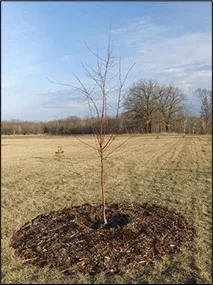
- Apply 2–4 inches of organic mulch around the tree, extending several feet beyond the canopy
- Keep mulch several inches away from the trunk to prevent excess moisture on the bark
- For public parkway trees, consider removing turf between sidewalk and curb — benefits the tree and simplifies mowing
Tip: Mulch should not exceed 4 inches in thickness. Too much mulch can:
- Block water and irrigation from reaching roots
- Cause root growth into mulch, leading to circling or girdling roots
- Reduce oxygen around roots and suffocate them
- Keep poorly drained soils too wet, promoting root rot
- Keep bark overly wet, leading to decay
- Create a habitat for rodents that can damage trees
Visual Guide:
Proper Mulch Depth and Placement